What Buyers Should Know About Sourcing Garden Supplies Wholesale from China
Wholesale garden supply sourcing may span many product types, materials, and factory processes. Buyers should define each SKU, intended use, seasonal timing, sample evidence, packaging, and delivery assumptions before comparing offers. A category-by-category plan makes capacity gaps and substitutions visible.
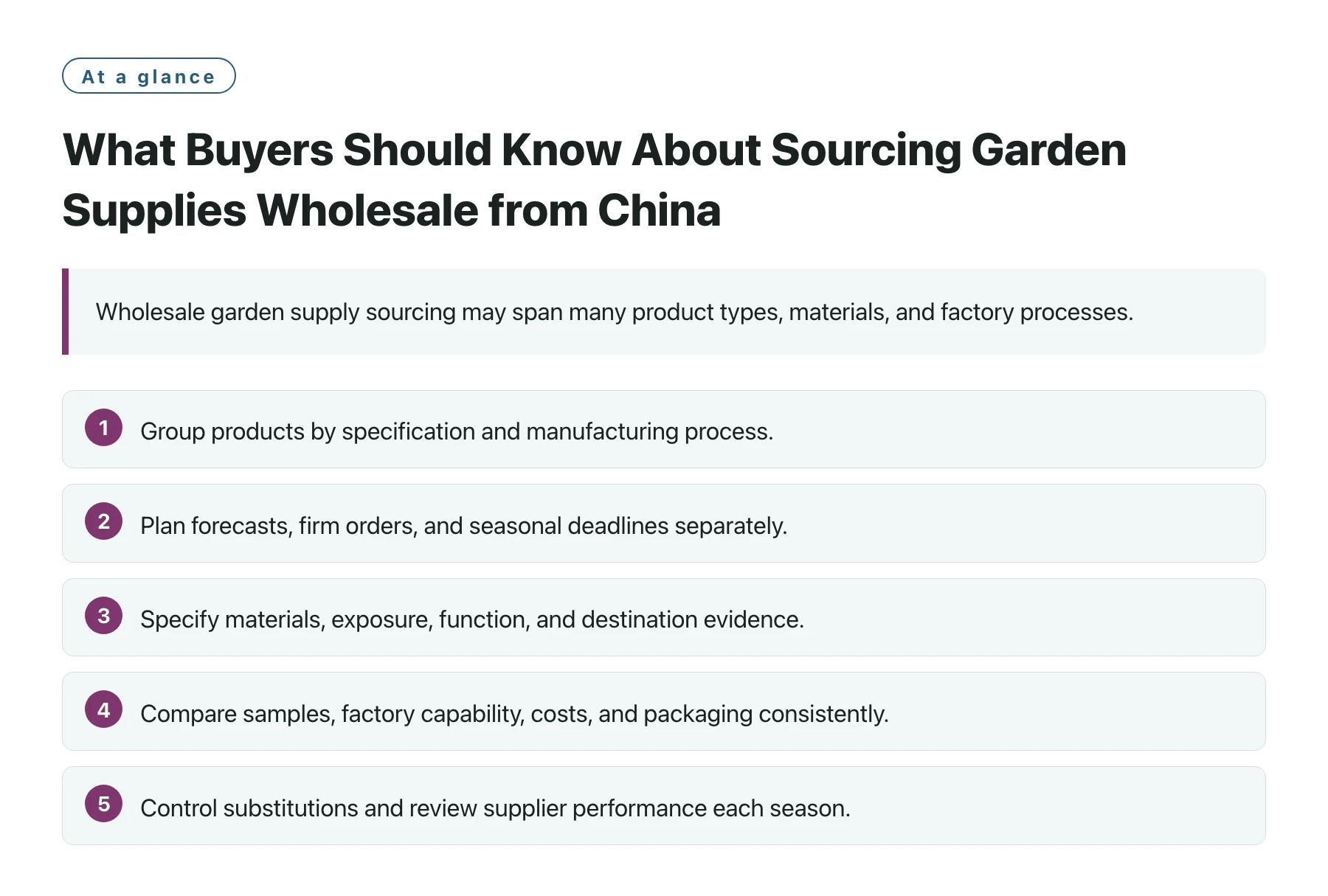
Key takeawaysGroup products by specification and manufacturing process. · Plan forecasts, firm orders, and seasonal deadlines separately. · Specify materials, exposure, function, and destination evidence. · Compare samples, factory capability, costs, and packaging consistently. · Control substitutions and review supplier performance each season.
A clear SKU matrix helps buyers compare suppliers and manage multi-category seasonal orders.
1. Define the garden product range
List product categories such as planters, hand tools, irrigation parts, hoses, trellises, outdoor décor, garden furniture, storage, and seasonal goods. Each item may use a different factory process, material, and market requirement. Avoid treating a broad catalog as a single capability.
Set model, dimensions, materials, finish, color, accessories, packaging, and target market for each SKU. Group products only when they share a real specification and production route.
Also record pack size, display requirements, and assortment for retail or wholesale distribution. If items are sold as sets, identify included pieces, assembly instructions, and how the factory checks that every carton contains the complete set. Keep product codes stable across quote, sample, carton, and invoice.
2. Match products to seasonal demand
Map forecast months, order cutoffs, production lead time, peak sales dates, and replenishment windows. Identify items that are weather-sensitive, seasonal, or difficult to substitute. Confirm how early the factory needs a forecast to reserve materials or capacity.
Separate planning forecasts from firm purchase orders. State how quantity changes, cancellation, or delayed delivery affect price, reserved materials, and production slots.
Plan packaging artwork and order placement early enough to reserve print capacity. If forecasts may change, agree how much stock or packaging the supplier may prepare before a firm order and who pays for unused custom material.
3. Specify materials and conditions of use
Record intended environment, UV and moisture exposure, soil or water contact, temperature, load, cleaning, storage, and expected use. Name polymers, metals, woods, coatings, textiles, and hardware where relevant; define acceptable equivalents only through written approval.
For products involving chemicals, electricity, water pressure, child use, load-bearing structures, or food contact, have qualified reviewers identify applicable requirements for the destination market. Do not accept broad “outdoor safe” claims without scope and evidence.
4. Compare quality and sample evidence
Request a production-representative sample and check dimensions, function, finish, edges, assembly, corrosion protection, drainage, packaging, labels, and accessories as applicable. Document product code, factory, revision, and sample status.
Define measurable acceptance criteria and test methods for performance claims that matter to the buyer. A showroom sample may use special components or hand finishing, so ask how production will match it and what process evidence is available.
5. Verify supplier capability by category
Ask who manufactures each product, which processes occur in-house, and which are subcontracted. Check similar products, capacity, production schedule, material sources, quality checks, packaging, and export experience. Confirm whether a trading company coordinates multiple factories.
Use a category matrix to compare supplier strengths, evidence, minimum order, lead time, open issues, and commercial terms. Avoid choosing a single source for a diverse range without checking capability and continuity risk.
6. Normalize wholesale quotes
Compare unit, carton, set, and pallet quantities consistently. Record minimum order, price tiers, sample and tooling fees, color options, labels, packaging, spares, warranty, payment, and price validity. Ask vendors to itemize exclusions and substitutions.
Calculate total cost using the same quantity, packaging, freight assumptions, and delivery point. Check carton size and weight because bulky garden products can create freight cost even when unit prices appear low.
7. Plan packaging, labeling, and shipping
Define product protection, carton strength, separators, edge protection, moisture barriers, bundle marks, barcodes, assortment, and pallet rules. Seasonal and multi-SKU orders need clear marks so warehouses can identify variants and replenish accurately.
Write the chosen delivery rule and named place in the contract. ICC Incoterms® rules clarify specified delivery tasks, costs, and risks between seller and buyer; separately confirm packing, customs documents, unloading, and destination charges. [1]
8. Coordinate quality checks and change control
Set checks for sample approval, production readiness, in-process monitoring, final goods, packing, and shipping documents. Identify who may accept deviations and how the supplier reports a material or factory change.
Require review when changes affect materials, coating, dimensions, intended use, labels, packaging, subcontractor, or manufacturing site. Retain approved references and tie each order to its revision.
During production, request status evidence tied to the actual order and identify any delay that threatens the selling season. Decide early whether to split shipments, revise assortment, or move quantity to a later season rather than making an undocumented substitution.
9. Plan repeat orders and customer support
Agree spare parts, replacement availability, warranty, product instructions, assembly guidance, and response route for defects. Keep batch identity so feedback from retailers or customers can be traced to the supplier and production lot.
Buyers comparing wholesale outdoor and garden products can request one SKU matrix for sample status, documentation, capacity, packaging, seasonal lead time, and price assumptions. Review supplier performance after each season.
Sources
Frequently asked questions
What details should a garden supply RFQ include?
Include SKU, intended use, materials, dimensions, finish, quantity, packaging, label, destination, delivery date, evidence, and acceptable alternatives.
How early should seasonal products be ordered?
Plan backward from sales and delivery dates using sample, production, packing, transit, customs, and receiving lead times.
Can one factory supply every garden category?
Only if capability and process evidence support each product group; verify subcontracting, quality controls, capacity, and continuity.
What should buyers check on a garden product sample?
Review identity, dimensions, function, materials, finish, assembly, labels, accessories, and packaging against written criteria.