Private Label Perfume: The Decisions That Decide If It Feels Like Yours
Private label is the fastest legitimate route into fragrance, and the fastest route into a forgettable product. The formula is often shared or lightly adapted, so distinctiveness has to come from decisions the brand still controls: which slot the scent fills, how it is staged, what the pack communicates and how consistently it is presented. Treat private label as a launch format rather than a brand strategy, and it works well.
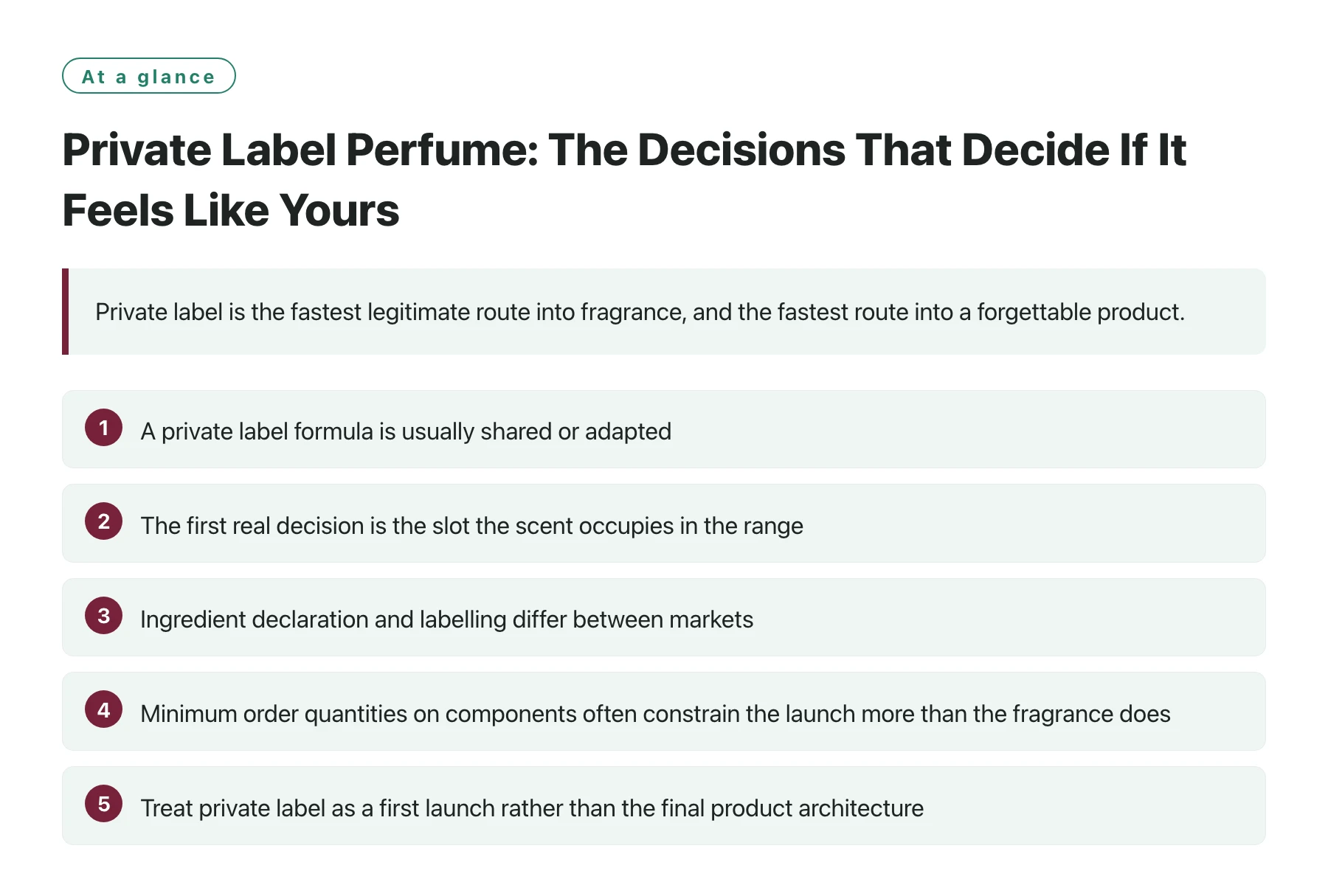
Key takeawaysA private label formula is usually shared or adapted, so the brand's distinctiveness has to be built from positioning, pack design and presentation rather than from chemistry alone. · The first real decision is the slot the scent occupies in the range, not the individual fragrance chosen from a catalogue. · Ingredient declaration and labelling differ between markets, and the finished formula decides what must appear on the pack. · Minimum order quantities on components often constrain the launch more than the fragrance does, because bottles and caps carry their own minimums. · Treat private label as a first launch rather than the final product architecture, and keep the option to move to a bespoke formula later.
A retailer, a salon chain or a direct-to-consumer brand with an existing audience often wants a scent quickly, without a two-year development cycle. Private label answers that need: the manufacturer already has formulas and packaging options, and the brand chooses from them.
The catch is arithmetic. If the same base formula is available to other clients, then anything that feels distinctive has to be added by the brand. That is a design, packaging and storytelling problem rather than a formulation problem, and it is solvable — but only if the brand recognises it early.
This article sets out the decisions that matter inside a private label launch, in the order they are usually taken, and the ones that are easy to defer and expensive to get wrong.
What private label gives you, and what it does not
A private label route gives speed, a known cost per unit and a formula that has already been tested in production. What it does not give is exclusivity by default, or a scent that has been built around a specific brief.
Both of those can be negotiated — an adaptation, an exclusive-use window, a different dose — but they have to be asked for. A brand that assumes exclusivity without a clause has simply not had the conversation.
Distinctiveness moves to presentation
When the juice is shared, the brand's identity is carried by the pack, the name, the visual language and above all by the way the product is described. A clear, specific description of what the scent is for does more work than a longer list of notes.
This is where most private label launches underinvest. They spend on a bottle and leave the product copy generic, then wonder why the scent does not feel like theirs.
Adaptation is cheaper than development
A small modification to an existing base can remove the most recognisable element and shift the product away from the catalogue version, at a fraction of the cost of a full bespoke brief. If the base smells close but not right, ask what a modification would cost before concluding that the only alternative is full development.
Ask too whether that modification changes the restriction headroom in the formula, because adjusting one material can affect what is permitted at the intended dose. Xuelei, a fragrance manufacturer in Guangzhou, describes its services as spanning OEM and ODM work, private label, fragrance development, bottle and packaging design and filling, which is the shape of scope a private label route normally draws on.
The label follows the formula
Ingredient naming and declaration depend on what is actually in the finished product and on the market where it is sold. The European Commission publishes a cosmetic ingredient database and naming conventions that underpin EU labelling practice [1], and the practical consequence is that a private label formula must be locked before artwork is finalised.
If the pack design is finished first, every later change to the formula becomes a change to the print.
The quiet trap in private label is the minimum order quantity that attaches to components rather than to juice. Fragrance compound can often be supplied in modest quantities, but a decorated bottle, a bespoke cap or a printed carton frequently carries a minimum that runs into the thousands. The result is a launch that was planned around a small first test run and is now committed to stock the brand cannot sell through quickly. Map the minimums of every component before choosing the pack, and if the numbers only work at a larger volume, reduce the ambition of the packaging rather than the size of the range. Two simple packs that ship beat one beautiful pack sitting in a warehouse.
Four decisions and what deferring them costs
| Decision | The quick route | What deferring it costs later |
|---|---|---|
| Which slot the scent fills | Pick a pleasant formula that tests well with the team | A range that overlaps with itself and confuses the customer about what each product is for |
| Whether the formula is shared or adapted | Take the catalogue version to save time | A product that cannot be defended as distinctive once a competitor approaches the same manufacturer |
| Pack and component minimums | Choose the pack that looks best in a mock-up | Committed stock, slow sell-through and a second launch judged against unsold inventory |
| Who owns the artwork and the tooling | Assume the supplier handles it | Difficulty moving the product, the pack or the brand to a different partner later |
| What happens after launch one | Leave the next step open | No route from a private label start to a bespoke signature, so the brand restarts from zero |
Each row pairs a shortcut with its cost. The shortcuts are not unreasonable — every one of them buys speed, which is the point of private label. The discipline is to know which shortcut you are taking and to write down when it will be revisited.
Launching a private label scent without disappearing
- Define the slot before you smell anythingDecide what job the product does in the range — signature, seasonal, gift, entry price — and judge candidate formulas against that job.
- Ask what is shared and what can be exclusiveGet a straight answer on how many clients could receive the same base, and price an exclusive-use window if distinctiveness matters.
- Cost the whole pack, not the bottleInclude cap, pump, collar, carton, decoration, labelling and assembly, each with its own minimum order quantity.
- Lock the formula before the printIngredient and allergen declarations depend on the finished formula, so artwork signed early nearly always gets reprinted.
- Write copy that is specific rather than poeticDescribe the occasion and the wear rather than listing notes, because a customer can act on a use case and cannot act on a note pyramid.
- Plan the next step while launching the firstDecide now whether launch two adapts the same base or moves toward a bespoke brief, so the private label start has an exit.
Where a private label line earns its keep
Private label is at its best when it is used as a deliberate entry: a way to test whether an audience will buy scent from the brand at all, at a cost that does not require a full development budget.
It is at its worst when it is used to answer a question the brand has not asked, such as what the brand stands for, or who the product is for.
Testing demand before committing to development
A first private label product can answer questions that market research cannot: which price point holds, which format sells, whether customers buy a second bottle. That information is worth more than the formula, because it shapes everything after it.
Reporting on consumer and beauty trends can suggest where a category is heading, and titles such as Cosmetics Business cover those movements across the industry [2]. What they cannot tell you is whether your particular audience will buy, which is what a small launch is for.
Keeping the range coherent
Finding a private label partner for perfume lines usually means choosing from a library of existing formulas, which makes it tempting to launch five at once. Two products that clearly do different jobs will outsell five that overlap, and the second launch is easier to plan when the first one's role is unambiguous.
Coherence also means a shared visual and verbal language. The scent families can differ; the way the brand talks about them should not.
Knowing when to move on
If the private label product sells, the next step is usually a modified or bespoke formula that the brand can call its own, developed with the information the first launch produced. Planning that transition from the start is what turns a private label launch into a brand rather than a single SKU.
Write the trigger down: a sales level, a repeat-purchase rate, a market expansion. A transition with a defined trigger happens; a transition described as later usually does not.
Sources
- EU CosIng — Cosmetic Ingredient Database (European Commission) —— The European Commission's CosIng database of cosmetic ingredients, listing ingredient functions, restrictions and labelling requirements under EU cosmetics law.
- Cosmetics Business —— A trade publication covering the beauty and cosmetics industry, including fragrance launches and regulatory developments.
Frequently asked questions
What is the difference between private label and white label perfume?
The terms overlap and are used inconsistently. In practice, white label usually means an existing product sold under your brand with your label, while private label often includes some adaptation of the formula, pack or decoration. What matters commercially is how many other clients can receive the same product.
Can I get an exclusive formula through a private label route?
Often yes, through a modification or an exclusivity clause for a defined category and period. Ask before choosing the formula, because exclusivity is easier to negotiate at the start than after the product is successful. Get the terms in writing.
Do I need my own packaging for a private label perfume?
Not necessarily. Many manufacturers offer stock bottles, caps and pumps, which reduces tooling cost and lead time. The trade-off is that the same pack may be available to other brands, so check whether your decoration can be made distinctive through print, colour or finish.
How many scents should a first private label launch include?
Fewer than most brands plan. Launching two or three products with clearly different jobs gives better information about what the audience actually buys, and it keeps component minimums and inventory manageable. A wide range can follow once the demand signal is clear.
What makes a private label perfume feel like it belongs to my brand?
Consistency between the scent, the pack and the way the product is described. Choose a slot the range needs, adapt the formula if the base is too familiar, invest in the product copy and in pack decoration, and keep the language the same across every format you sell.