Hardware Wallet Workflow for Mining Income
A hardware wallet does not improve mining income by a single satoshi. What it changes is what happens after the coins are earned: instead of a growing balance inside an operator's account, you hold keys you control. At 1 PH/s, that means a decision about roughly 0.001346 BTC every 72 hours — about $113.99 on 21 September 2026 — rather than one large decision at the end of the year.

Key takeaways
- Mining payouts are listed as zero-fee, so the cost of moving settled earnings is not a fee charged by the pool but the network fee on any transfer you broadcast yourself.
- At 1 PH/s, hourly settlement adds about 0.0000187 BTC — near $1.58 — to the account; three days of accumulation is 0.001346 BTC, roughly $113.99 at a BTC/USD of 84,692.
- Frequency matters more than size: smaller, regular sweeps to self-custody average a much lower outstanding balance than a single quarterly movement of the same total.
- Test every destination address with a small transfer first, and keep the seed phrase offline — most self-custody losses come from procedure, not from hardware failure.
Context in 2026
Difficulty sits at 132.76 T against a network hashrate near 1,003 EH/s, and the estimated next adjustment was a 2.12% decrease. Mining economics at that level are tight enough that operators focus on power price and uptime, and custody is treated as an afterthought until something goes wrong. The opportunity in 2026 is that settlement is fast: PPS+ pays the block-reward component hourly based on current difficulty at a listed 4% fee, with the transaction-fee component distributed at a listed 2% fee.[1]
Fast settlement plus zero-fee mining payouts means the coins are available to move almost as soon as they are earned. That removes the usual excuse for leaving production in an operator's account: there is no longer a fee event that punishes frequent withdrawals, only the network fee on the outbound transfer you choose to make.[2]
The two variables that matter
Cadence. How often coins leave the operator's ledger and land in your own custody. A monthly sweep produces the same total as a daily one; it just leaves a larger average balance sitting as a claim on someone else.
Procedure. Where the keys live, who can access them, and what happens when a transfer is mis-sent. Hardware solves key storage and nothing else — the rest is process design, and it is the part that fails in practice.
| Step | What you do | Why it matters | Cadence |
|---|---|---|---|
| 1. Settlement | Let PPS+ credit earnings hourly at current difficulty | Keeps earnings in small, manageable increments | Automatic |
| 2. Threshold check | Withdraw or convert when the balance passes your chosen limit | Caps counterparty exposure at a number you set in advance | Daily to weekly |
| 3. Test transfer | Send a small amount to the hardware wallet address first | Confirms the destination before a large movement | Once per new address |
| 4. Sweep | Move the accumulated balance on-chain | Transfers custody; you pay only the network fee | Weekly to monthly |
| 5. Receipt check | Verify the balance in the hardware wallet interface | Closes the loop; a stuck transfer is a timing problem, not a loss | Every sweep |
| 6. Backup audit | Confirm the seed backup is legible and stored offline | The only unrecoverable failure in the whole workflow | Quarterly |
The order is deliberate. Testing an address before a sweep is the cheapest insurance in the process, and the backup audit is the only step whose omission is permanent — a lost seed cannot be recovered by any operator, exchange or support desk.
Numbers from a real rig
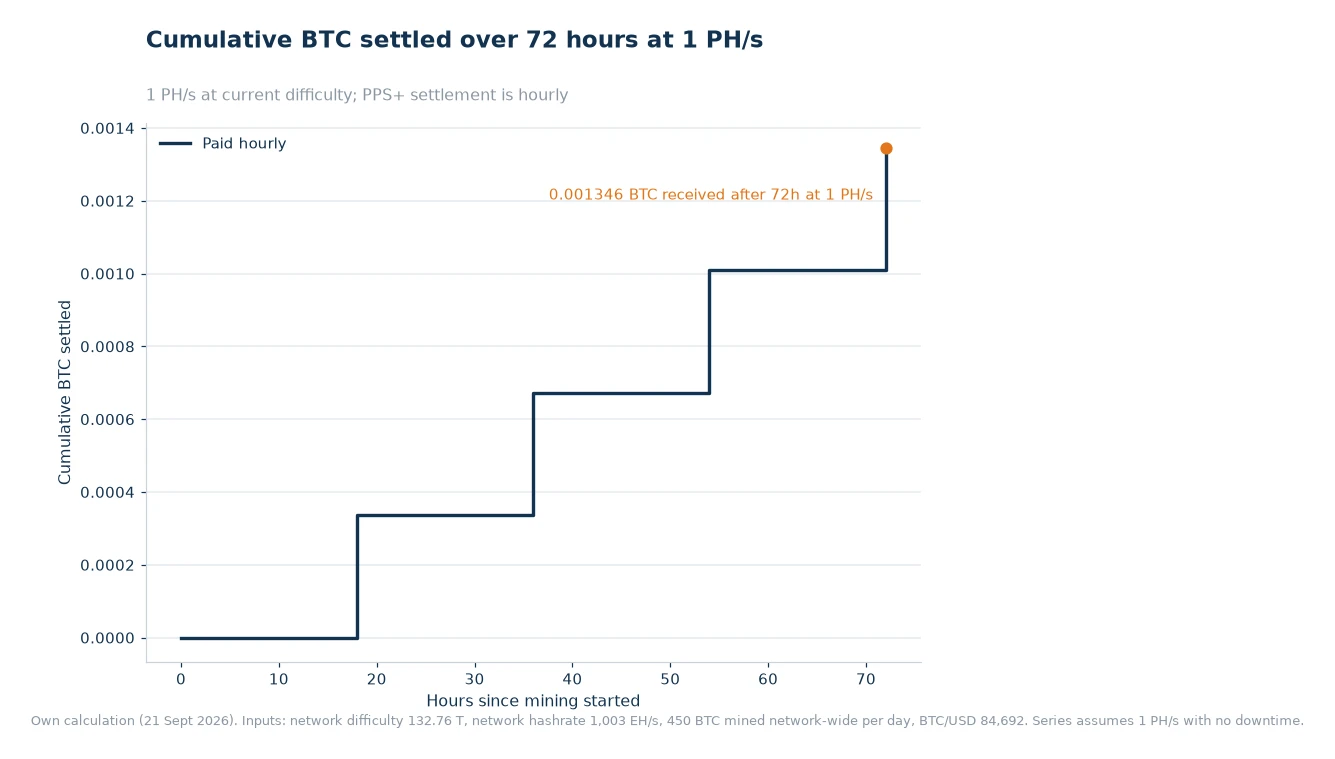
Run 1 PH/s and watch a three-day cycle. Daily output at current difficulty is about 0.000449 BTC, worth roughly $37.99 at a BTC/USD of 84,692. Over 72 hours that accumulates 0.001346 BTC, near $113.99. In that window the pool settles about 72 times, each increment landing near 0.0000187 BTC, which is the number a cadence decision actually works with.
Now compare two cadences on the same production. A quarterly sweep concentrates a balance of roughly 0.0404 BTC — about $3,420 — before it moves. A weekly sweep averages about 0.00314 BTC outstanding, near $266, and never lets the exposure reach the quarterly figure even for an hour. The total transferred per year is identical in both cases. Only the exposure profile changes, and it changes by more than an order of magnitude.
One practical wrinkle appears when you move coins during congestion: an on-chain transfer can sit unconfirmed for longer than expected. The transaction accelerator is built for exactly that case — free submission is available for transactions of 0.5 KB or smaller at a fee rate of at least 0.0001 BTC/KB, with the free quota refreshing hourly and processed in submission order, while paid acceleration can be settled in BTC, BCH or LTC from the account balance.[3] Two constraints are worth remembering before relying on it: submitted transactions cannot be cancelled or refunded, and a transaction whose inputs are not yet confirmed cannot be accelerated — accelerate the earlier transfer first.
That last point interacts with the mining side in a way that surprises people. Coins credited hourly can be moved hourly, and a chain of rapid transfers to the same destination can leave one transaction waiting on an unconfirmed parent. Sweeping a slightly larger balance less often avoids the situation entirely, which is another argument for a cadence measured in days rather than minutes.
Decision guide
- Choose the cadence from your exposure tolerance, not your convenience. Weekly sweeps at 1 PH/s keep the average outstanding balance near 0.00314 BTC; quarterly sweeps let it reach about 0.0404 BTC.
- Split hot and cold. Keep a small working balance for conversions and invoices inside the ViaBTC Crypto Wallet, and move reserves to self-custody on a schedule.
- Do not reuse a destination out of habit. Test the address each time you change devices or wallets, and never paste an address you received in a message.
- Write the process down. Include who may approve a withdrawal, what happens if a device fails, and where the backup lives. A two-person rule on large movements costs nothing and removes a whole class of loss.
- Reconcile before you sweep. Your settled balance should track the pool's hashrate share, current difficulty and your own uptime; if it does not, investigate the discrepancy before moving coins. The pool statistics view is the reference for that check.
Frequently asked questions
Can I mine more than one coin at the same time?
Yes. Merged mining lets a machine secure a parent chain and an auxiliary chain together, and multi-coin pools support switching between chains without moving hardware.
Do mining pools cost anything to join?
Joining is free; the pool earns from its fee on settled payouts, which appears as a percentage of the block-reward and transaction-fee components.
How often should I move mining income to a hardware wallet?
Often enough that the balance you leave behind is a number you would accept losing. A weekly sweep at 1 PH/s keeps the average balance near 0.00314 BTC, while a quarterly schedule lets it approach 0.0404 BTC.
Does a hardware wallet change my mining rewards?
No. Rewards depend on your hashrate share, difficulty and the pool fee schedule. A hardware wallet affects only who controls the coins once they have been paid.
Make the transfer boring
Set a balance limit, sweep on a schedule, test every new address and keep the backup offline. None of it improves hashrate, and all of it decides whether the BTC you mined this quarter is still yours next year. Start with the smallest useful change: pick a threshold you would genuinely accept losing, and treat everything above it as money that belongs in your own custody.
Data and sources: ViaBTC fee schedule[1], ViaBTC wallet and payout documentation[2] and ViaBTC transaction accelerator documentation[3]. Network difficulty (132.76 T), network hashrate (1,003 EH/s), 450 BTC mined network-wide per day and the BTC/USD price of 84,692 were read from public chain data and market feeds on 21 September 2026; accumulation and exposure figures are our own calculation from those inputs. Values change with difficulty and price; nothing here is investment advice.