Comparing Two Monthly Plans on Cost per Message
The useful unit for comparing two monthly plans is not the headline on either one - it is minutes per message. Writing a message takes about 30 seconds and reading the reply takes roughly twice that, so a message costs around 1.5 minutes of your attention at any volume. What differs between a light month and a heavy one is the size of the bill, not the rate: 540 messages is 13.5 hours, and 1,800 messages is 45 hours.

Key takeaways
- Price the message, not the month: at 30 seconds writing plus a minute reading, every message costs about 1.5 minutes.
- Volume multiplies, rates do not. 540 messages is 13.5 hours; 1,800 messages is 45 hours - 3.3 times the volume for 3.3 times the time.
- The fixed part of a habit - browsing and choosing - shrinks as a share: 52 minutes a month is 29% of a light profile and under 2% of a heavy one.
- No prices or plan names appear in this article; the platform's own plan page states its current offer, and the comparison here is in minutes.
Why the rate barely changes
Conversation is a constant-speed activity. A message of normal length takes about 30 seconds to write, the reply takes longer to read than to compose, and neither number moves much when you send more of them. That is why a per-message comparison tends to produce a flat line across a wide range of volumes, and why offers that look different in size often differ only in how much of the month they cover.
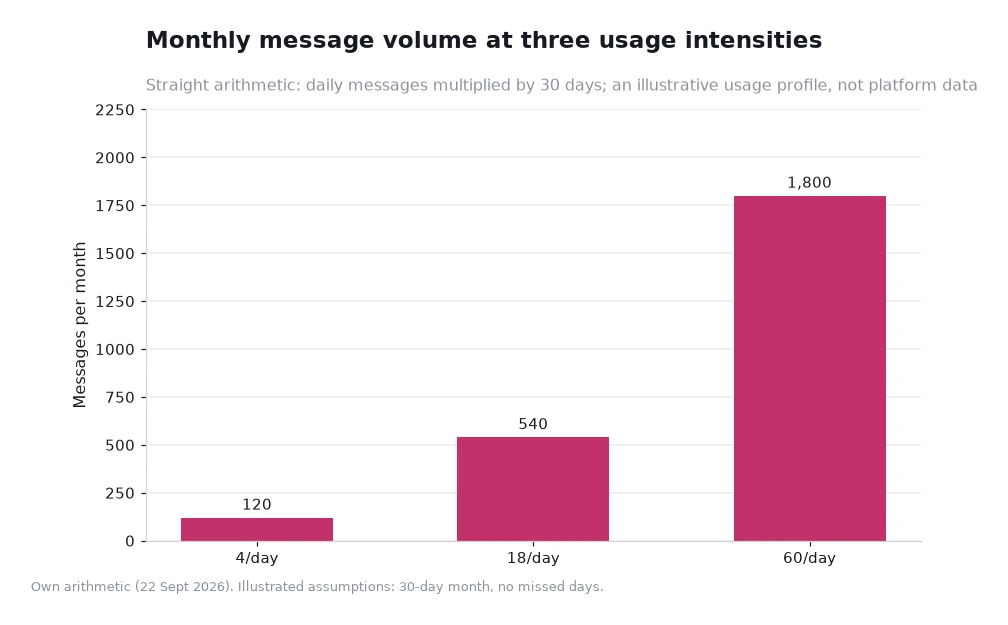
The variable part is volume, and volume is entirely yours. Daily counts against a 30-day month give 120 messages at 4 a day, 540 at 18 a day and 1,800 at 60 a day. Converted with the 1.5-minute rate that is 3 hours, 13.5 hours and 45 hours. A plan does not change any of those three numbers; it changes whether a limit would ever interrupt them.
The second variable is the fixed overhead, which does shrink with volume. Choosing cards, reading descriptions and adjusting a setup takes a fairly consistent amount of time each week - say twelve minutes, or about 52 minutes a month. On a light profile of 180 minutes that overhead is 29% of the whole habit; on a mid profile of 810 minutes it is 6.4%; on a heavy profile of 2,700 minutes it is under 2%. Heavier use is more efficient use, which is a real argument, just not the one marketing copy usually makes.
Putting two profiles side by side
Take two monthly profiles rather than two price tiers: Profile A at 18 messages a day and Profile B at 60. Profile A sends 540 messages in 30 days, writes them in 270 minutes and reads the replies in roughly 540 minutes, for 810 minutes - 13.5 hours. Profile B sends 1,800, writes them in 900 minutes and reads for 1,800, for 2,700 minutes - 45 hours.
Read the two totals together and the choice becomes obvious. Profile B is 3.3 times Profile A on every axis: three times the messages, three times the writing, three times the reading. There is no efficiency hidden in the larger number, only scale. Anyone choosing between them is deciding how much of a month to spend, not which one is cheaper per unit.
The one asymmetry is the overhead above. Profile B amortises the 52 minutes of monthly browsing across 2,700 minutes, so almost all of the heavy month is conversation. Profile A spends nearly a third of its time choosing - which suggests that if you like browsing but not long sessions, the light profile is the one that needs a tighter selection routine rather than a bigger allowance.
| Profile | Messages per month | Writing and reading time | Overhead share |
|---|---|---|---|
| Light: 4 messages a day | 120 | 3 hours (60 minutes writing, 120 reading) | 52 minutes is 29% of the total |
| Middle: 18 messages a day | 540 | 13.5 hours (270 minutes writing, 540 reading) | 52 minutes is 6.4% of the total |
| Heavy: 60 messages a day | 1,800 | 45 hours (900 minutes writing, 1,800 reading) | 52 minutes is under 2% of the total |
| Rate per message | Same at every profile | About 1.5 minutes each | Flat, which is why it cannot decide the choice |
| What a plan changes | Whether a limit interrupts you | Not the time a message costs | Nothing about the overhead |
Worked example: from daily count to hours in four lines
Line one: messages a day times 30. At 18 that is 540. Line two: writing time, at 30 seconds a message, which is 540 times 0.5, or 270 minutes. Line three: reading time, at about a minute a message, which is 540 minutes. Line four: add them for 810 minutes, and divide by 60 for 13.5 hours.
Run the same four lines at 60 a day and the totals multiply by 3.3: 1,800 messages, 900 minutes of writing, 1,800 minutes of reading, 45 hours. Then compare the two answers as a single sentence: the difference between the profiles is 31.5 hours a month, which is roughly an hour a day, and that - not the wording on a plan page - is the decision in front of you.
Two things to keep in mind while doing this. The reading estimate assumes replies are about twice the effort of your own messages, which is a reasonable convention rather than a measurement, and it is the largest single assumption in the arithmetic. And the profiles are illustrative usage assumptions, not platform data; they describe how the multiplication works, and your own log is the only honest input.
Where the plan page fits into the arithmetic
A plan page answers one question: does anything interrupt the profile you actually run? If your month is 540 messages and no limit bites at that volume, the page is irrelevant to you. That is not a criticism of the offer; it is the correct conclusion from your own numbers, and it saves a decision.
So do the arithmetic first, then read the offer. If you want the terms as the platform states them, the unlimited plan page is the only place where the offer is written down by the seller, and this article deliberately quotes no figure from it - no price and no plan name appears here, because the comparison it makes is in minutes. For the boundaries that apply regardless of volume, the FAQ on the Crushon page for porn ai chat uses the platform's own term, Porn Chat AI, and states that some limitations apply under its content and community guidelines.
One last habit that makes the arithmetic worth doing: log the three inputs for a fortnight - sessions, minutes per session, messages sent - and recompute. A fortnight of data replaces the illustrative profiles above with your own, and after that any plan comparison takes two minutes a month. The weekly rankings are useful here for a mundane reason: a shorter shortlist means less browsing, and browsing is the overhead that makes light profiles expensive.
Frequently asked questions
How do I compare two plans without prices in front of me?
Compare them in minutes. Messages a day times 30 gives the volume, and about 1.5 minutes a message gives the time: 120 messages is 3 hours, 540 is 13.5 hours and 1,800 is 45 hours.
Does a heavier month cost less per message?
Not in conversation time - that is flat at roughly 1.5 minutes a message. It does spread the fixed browsing overhead thinner: 52 minutes is 29% of a light month and under 2% of a heavy one.
Which profile should a new reader start with?
Log a fortnight first. Without your own three inputs - sessions, minutes a session, messages sent - any comparison is against illustrative profiles rather than your habit.
Do the four lines, then read the offer
Write the four lines for the volume you think you run, then for the volume you actually ran last month, and compare. If the two match, read the plan page once to check that nothing interrupts you and leave it alone. If they do not match, the arithmetic has told you something more useful than any offer could, and the fix is a session cap rather than a plan change.
Data: card counters and FAQ wording from the client's own pages, read 22 Sept 2026[1]. Message volumes, minutes and percentages are own arithmetic presented as an illustrative profile, not platform data; no price, plan name or user total is quoted anywhere in this article. Written for readers aged 18 and over.